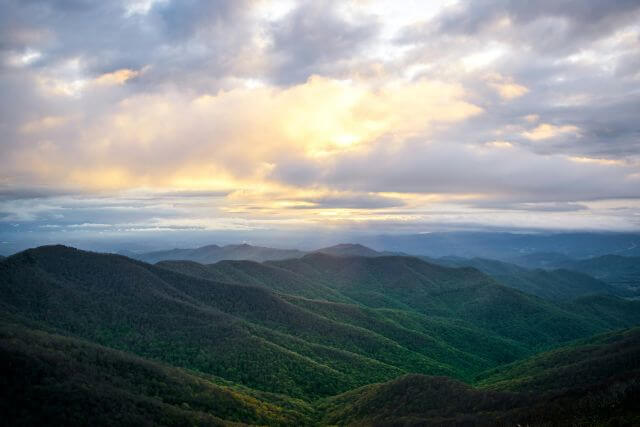
“I am a national park ranger from the Blue Ridge Parkway. Has anyone heard of the Blue Ridge Mountains?”
Five or six tentative, tiny hands climbed into the air. I was speaking to a room full of first graders at an elementary school in Roanoke, Virginia.
I pointed to the mountains visible from their classroom windows. “Those are the Blue Ridge Mountains,” I told them, “and they’re some of the oldest mountains in the world. You live in a special and beautiful place.”
Like these children, I grew up in the Appalachian mountains, south of Roanoke, in Knoxville, Tennessee and Asheville, North Carolina. I first fell in love with nature in the Blue Ridge and Smokey Mountains, links in the Appalachian chain, those ancient and eroded peaks that have stood since the North American continent was still one with Africa.
As a child, I hiked to Appalachian waterfalls edged with wildflowers and mountain laurels, drank hot cocoa in the shadow of snow-dusted Appalachian peaks, imagined fairies and elves tucked away in the range’s deep forests, and added broken pieces of the mountains themselves to my rock collection.
This was the place that started me on my journey to becoming a US national park ranger. These were the mountains I left when I began my first drive across the country to Alaska to my first national park job. Years later at the Blue Ridge Parkway, in what would be my final job as a park ranger, I was returning to them.
I was ready to find my place.
After four ranger seasons in Southeast Alaska–two in Skagway and two in Glacier Bay–I had been ready to move on. I decided to try out different parks, ones in the lower 48. I wanted to discover where I’d like to live and what I wanted from the next stage of my career.
I spent a summer at Glacier National Park and another at Olympic National Park, both of which felt like imitations of Alaska and not quite as spectacular as the real thing—the mountains not as high, the wilderness not as wild, the trails I wanted to hike hours away by car instead of five minutes from my front door, and all of it filled to the bursting point with so, so many people.
I worked winters in Del Rio, Texas, at Amistad National Recreation Area, where I discovered that—though I appreciate its stark beauty—I am not a desert person. This self-discovery was confirmed at Zion National Park, where I lasted one scorching summer, celebrating with a little dance the rare days when the temperature didn’t veer into triple digits.
I spent time in Sleeping Bear Dunes National Lakeshore along the chilly edges of Lake Michigan, scanning the beaches for Petoskey stones (although, like any rule-abiding park ranger, I left them where I found them).
What I discovered on my paid tour of some of America’s most spectacular places was that, though I grew to care for them all, not one of them felt like home.
Sometimes my colleagues would say, “This is my favorite park; I came here and never left.” I was fascinated by this concept. I waited for a similar epiphany to happen to me—this, this is the spot I’ve been waiting for!—but none came.
Each park is someone’s favorite, but no park was mine. And so I kept moving, sometimes because I didn’t like the job, sometimes because budget cuts or other technicalities meant I couldn’t come back the next season, but most often because I just wanted to see what else was out there.
What I eventually discovered was that I was no longer happy in my nomadic, seasonal life. I was ready to find my place.
The park’s entire children’s educational program had been snipped from the budget.
I landed a job that lasted a year at the Blue Ridge Parkway in Virginia, a student position, where I could work on online grad school and be closer to my family than I had been in years.
I had searched for a park that felt like home all over the continent, and I had finally found one, back where I had begun. I was thrilled to live once again in my native mountains and to share my love of them with a new generation. I would be running an educational program, visiting schools to teach children about the mountains we called home.
Technically I was hired at the parkway as an intern (a regression which seemed somehow fitting after nine years of working at an agency legendary for not promoting its staff), and, as a student hire, I was told I could stay for a full year, rather than the typical six months.
I will spare you the sordid details, but I lost that job multiple times over the course of the year, informed over and over that I did not meet the exact hiring requirements. The rules seemed to keep changing—one hiring official would tell me that I should never have been hired, the next that there was no issue and to keep doing my job.
Over time the problem changed from being about my student credentials to being about the park budget. My supervisor couldn’t seem to figure out where the money was coming from to pay my salary, and she assured me numerous times that her boss intended to let me go before my contract was up.
I can’t tell you the stress of coming to work every day, fearing that–through no fault of your own–this might be the day you lose your job. Yet somehow, after limping through this nightmare for an entire year, I came to the end of my contract. I spoke to someone in the regional office about my closing paperwork, and she asked why I was leaving at all, informing me that I could stay on another five months, until my master’s graduation.
When I asked my supervisor about staying longer, she informed me that there was no money left for my position, that in fact the park’s entire children’s educational program had been snipped from the budget.
National parks have been struggling for over a decade to maintain their infrastructure and retain staff.
Throughout my final National Park Service (NPS) job, I carried a rectangle of pink paper in my green, wool pants pocket emblazoned with the not at all awkward title: “My NPS Manifesto (lol): For Making Them Better.”
It was 2019, and many candidates were vying to be the next President of the United States, all of them proclaiming bold plans for the nation. I decided to create my own platform, one for improving national parks.
On my little pink proclamation, I wrote about grievances, but I also wrote about my hopes. Increased budget for deferred maintenance, improved hiring practices, and better protections for employees.
I hoped for an NPS where a ranger could move up the ranks at a park in their backyard, a park they knew and grew up loving, a park they had dreamed of working at their entire lives.
Now that my program at the Blue Ridge Parkway was being cut, there would no longer be a park ranger to go into nearby classrooms and tell the clueless children the names of the mountains they saw every day. There would be no one to help them learn to love these mountains the way that I had at their age.
There are a lot of problems with the way hiring works in national parks and the way that the parks are run. Even before the massive recent cuts to staff and funding, America’s national parks have been struggling to maintain their infrastructure and retain staff.
And as I saw while working there, the Blue Ridge Parkway was particularly hard-hit by infrastructure problems. The parkway always operated in the red, and every day I encountered symptoms of the park’s budget ills.
The side-road to a popular parkway lookout had crumbled off the back of a mountain during a recent storm, and, despite the daily questions I fielded about when it would reopen, there was no timetable or foreseeable funding for it to be fixed.
“You can hike up the section of road that didn’t wash away,” I would offer.
A nearby parkway campground had shut down a few years before I arrived because there was no funding to maintain it, and I was often asked when it too would reopen. “It’s also a great place to hike now,” was all I could tell them.
I myself liked to walk this closed campground loop, the road now fractured by the roots of plants and overgrown into a jungle of Appalachian fecundity in a scant few years. It amazed me how quickly the flora reclaimed the spaces the park had abandoned; it demonstrated something beautiful and wild and humbling about the power of nature to heal itself.
The fact that the forest had reclaimed this campground so quickly also highlighted how much work a national park maintenance crew must do to keep the parks operational and how little neglect it takes for them to fall apart.
Looking at the stacks of green wool pants and thick gray shirts, I lied and told her none of them fit.
On my last day working at the Blue Ridge Parkway, my supervisor administered my final paperwork, stripping me of my badges, my keys, and my radio. She asked if I would ever apply to a student program again.
“It was a headache,” she said.
I agreed that the student hiring had been problematic, but I told her it wasn’t just student jobs that I was giving up on. After all those years and all those parks, I had finally discovered that I would never find a home in the national parks. I would no longer be applying for any national park jobs.
“I quit the NPS a couple of times before I finally landed a permanent job,” she said. “It just takes a while, but you’ll come back.”
I had piled up my uniform pieces on one of the ancient green sofas that sat in the Mission 66-era home that I was now vacating, and I asked my supervisor to donate them to the uniform cache. She assured me that I would regret getting rid of them, that I should keep some pieces for when I returned to the park service.
Looking at the stacks of green wool pants and thick gray shirts, I lied and told her none of them fit. The truth was that I knew I was done, and I didn’t want to carry their weight on my next journey.
Inspired to support America’s public lands? Here are five ways you can help.