Welcome to the Park of the Month newsletter for August 2026. This month we’re featuring the most visited national park unit in Alaska.
Klondike Gold Rush National Historical Park
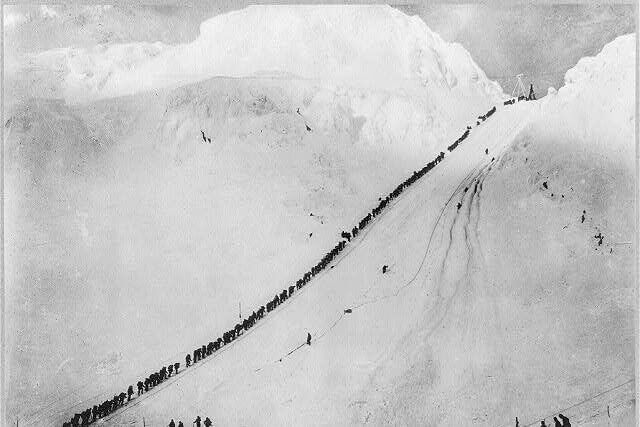
A line of gold-seekers summiting the Chilkoot Pass during the harsh winter of 1897-98. (Photo courtesy of the Library of Congress Archives)
Location
Seattle, Washington and Skagway, Alaska, US
Claim to fame
In the summer of 1896, gold was discovered along the Klondike River deep in Canada’s Yukon Territory. By the following year, news of the discovery hit an American people struggling through an economic downturn, and gold fever gripped the nation.
During the winter of 1897-98, 100,000 folks boarded ships in ports along the West Coast headed for the shores of Alaska. Once there they would need to carry thousands of pounds of gear tens of miles over and across mountains and then construct boats that could transport them hundreds more miles on the turbulent Yukon River. Only an estimated 20,000 to 30,000 of those who started the journey ever reached their final destination of Dawson City, and when they did arrive they would discover that the area had already been cleared of gold.
Reason to visit
Klondike Gold Rush National Historical Park is made up of two main US park units. One site is a museum in Seattle that highlights the impact the gold seekers had on the city when it was young. The other unit, in Skagway, Alaska, preserves most of the historic buildings of the town along with sections of the historic hiking routes that took gold-rushers through the mountains.
The Skagway unit of the park welcomes more than a million cruise ship passengers each summer, making it the most visited national park unit in Alaska. With dozens of 1800s-era preserved wooden buildings and boardwalks, the town has a Wild West feel right in the middle of remote and rugged Alaskan mountains, making it one of the more picturesque travel destinations in Southeast Alaska.
Wild Fact
The Klondike Gold Rush brought the first major influx of migrants from the US into what was then a newly purchased US territory. Some of these gold seekers remained to build new communities like Skagway, but they were not the first people in the region.
The Tlingit have lived along the Inland Passage of Southeastern Alaska for thousands of years. Skagway’s name is itself an anglicized version of the Tlingit word for “home of the north wind.” For the Tlingit and other indigenous Alaskans and First Nations people, the Klondike Gold Rush brought new threats to their land, livelihoods, language, and culture.
Thanks for reading. Each month, we send out an image and description of a unique natural or cultural treasure like the one above. Learn new things, explore special places, and find your inspiration: sign up for the free newsletter today.