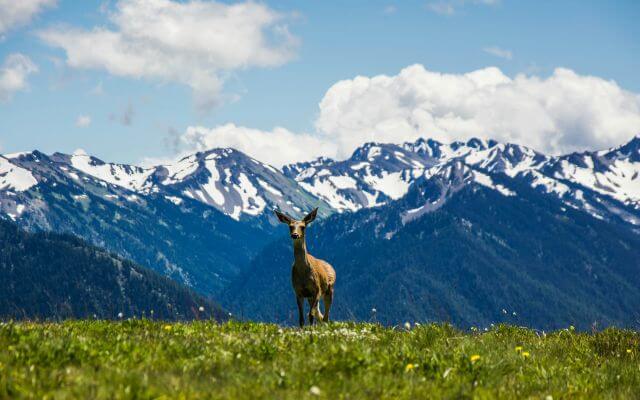
One afternoon while working as a ranger at Olympic National Park, I was hiking up a small hill on Hurricane Ridge, when a man approached me and said that he was afraid of mountains. This was the first time he had been on a mountain since he was a child: he said he was afraid of falling off one.
“Falling off a mountain?” I asked, trying to clarify. I tried to imagine what the man thought a mountain was—possibly a cartoon triangle, on which one had to constantly balance or go tumbling down. “Like, off a cliff edge?”
“No,” he said. “A mountain. When I was a boy we went to a mountain, and I fell and kept falling for a long time. I was injured and scared. I have never been on a mountain since.”
The man’s English was accented, and I learned that he and his family were visiting from South America. There are some tremendous mountains on that continent; if he had taken a bad fall on one, it made sense he might have emotional scars.
As we spoke, I was impressed with how the man understood his fear and how well he could articulate it. Especially while standing, with me, on a mountain.
Though it was only a little hill to me, that day this man hiked his mountain.
We were on a sturdy trail, broad enough for an entire family to walk together, with gently sloped edges on which one could easily arrest any fall. Still, he sought me out because he did not want to be alone. He told me about his childhood and his greatest fear as we hiked to the small viewpoint at the end of the trail.
I describe the trail as being up a hill, because it was not much higher than the parking lot, but to reach it we had all driven an hour up into the mountains. We were rubbing elbows with the highest mountains on the Olympic peninsula up here, some with glaciers still slicing their peaks. These were real mountains, the kind this man feared. And here he was, standing beside me, looking around, admitting that the mountains were beautiful.
Though it was only a little hill to me, that day this man hiked his mountain, and I hope he remembers it as the accomplishment of a lifetime, because for him it was.
National parks create these moments of accomplishment and growth for some people.
When I was a ranger, visitors rarely came to me like this man did and specifically asked for help overcoming their fears or their hurts, but this was often essentially what they wanted. They wanted someone to walk with when they were afraid of the bears, the snakes, the heights, or the mountains. They wanted someone to talk to or someone to reassure them when they were afraid or in pain.
I played all of these roles. I listened to visitor’s stories and witnessed awe-inspiring acts of everyday bravery. I am terrified of mountains and yet here I am, walking this mountain. That is not nothing. That is an event to be celebrated. While working with national park visitors, I was fortunate to be present for many such moments.
National parks create these moments of accomplishment and growth for some people, igniting their deepest fears and also the courage to overcome them.
If you are ever going to get over your fear of heights, then the Highline Trail in Glacier National Park—cutting along a narrow cliff edge in view of some of the most beautiful scenery in North America—might be the place to do it. If you are ever going to venture out into a landscape in which there are, on occasion, snakes, then perhaps Badlands National Park is your Everest.
My mother, who is terrified of snakes (the word itself causes her to shudder and gag), once took a short walk beyond a parking lot to get a better view of the Mars landscape that is the Badlands. She saw a cluster of people staring at the ground; one of them told her they were watching a rattlesnake take a nap. My mother did not die on the spot (as I would have predicted) but gave the group a wide berth and kept walking. She had an alien planet to investigate.
I have witnessed tremendous emotional healing in national parks.
The beauty of national parks, the distance people travel to reach them, and their otherworldliness and sacredness, often inspire in visitors more than just awe or a memorable experience. Sometimes people find something within themselves that they were not expecting, like that their desire to do or see something is greater than even their long-held fears.
There are other kinds of fears, though, that are not related to something physically present in the world. It makes sense to be afraid of a tarantula or a high precipice or a flood—these fears are programmed into us by the memories—ancestral or episodic—of our bodies, a product of their desire to keep us safe. The man who felt fear every time he looked at a mountain had a learned response to something that could cause him harm.
Not all harm is physical, though. Some wounds are emotional, and national parks can be the cause and cure for this kind of pain as well.
I have witnessed tremendous emotional healing in national parks too, and I have experienced some of my own. Those of us who support national parks say that we are protecting them, but I often think that they are doing just as much to protect us.
Inspired to support America’s public lands? Here are five ways you can help.