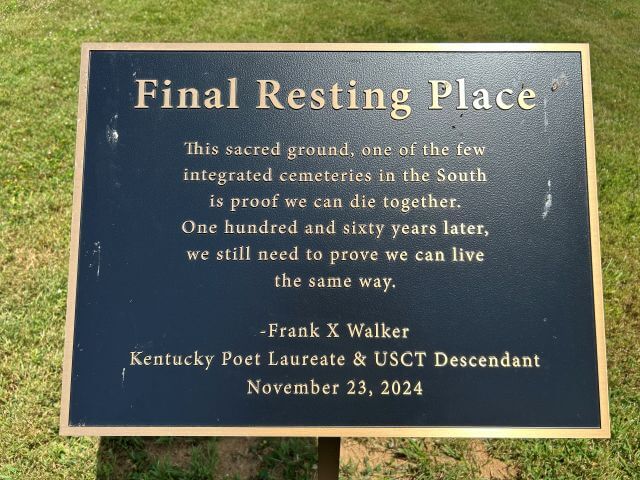
I cried leaving flowers at my uncle’s grave. It seemed like an appropriate time to cry, but the tears still caught me off guard. That morning I bought a little plastic vase with a sharp base that can be stabbed into the ground and three small sprigs of plastic flowers–red, white, and blue.
When I found the grave, someone had left a bracelet on top of the headstone, one of the dark stone bracelets my uncle enjoyed crafting at the end of his life. That was the only memento there. And I started weeping.
Something about the bracelet, how intimate a gift it had been, how his hands had made it, how one of my relatives or his friends had stood there and left that bracelet in honor of him. It made it all feel so real. He made art. He is dead.
There were so many stories at the park, of hope and also of horror.
I had also just been to the US Civil War site next door, a place that will move you to tears. Camp Nelson National Monument, a US Army supply depot, housed thousands of recently freed enslaved people during the war. By the end of the war it held a town for the formerly enslaved, with a school for teaching them reading and basic skills that might help them enter society as free people.
There were so many stories at the park, of hope and also of horror. At one point most of the refugees were kicked out of camp in winter, and about a quarter of them died from the cold, many of them young children.
During the war the formerly enslaved were not safe outside the camp, as most slave states (like Kentucky in which Camp Nelson sits) had laws about slaughtering them on sight or sending them back to their former owners. Until the war’s end, they couldn’t leave that camp without fear of murder or enslavement. And even after the war, there were decades of lynchings and racially motivated violence ahead of them.
These are the stories that national parks protect. This is why they are so vital. They keep the memory of what happened alive, so that we can understand our scars and so that we don’t repeat our mistakes. They help us understand more about who we are as a nation and as individuals.
In some strange way Camp Nelson seemed connected to my own life.
In some strange way Camp Nelson seemed connected to my own life. The supplies they stored were shipped out to battles in East Tennessee, in particular Knoxville (where I was born) and even more specifically Fort Sanders, the fort turned neighborhood where I lived when I attended the University of Tennessee.
These supplies were also vital to Union victories in West Tennessee, where I went to high school. And some of the Black soldiers who were freed, commissioned, and trained at Camp Nelson were stationed after the war on the border of Mexico and Texas, where I met some of their descendants while working at a park there.
Some Buffalo Soldiers were sent to Skagway, Alaska, the site of the first national park I worked at. Every day working there I showed visitors historic photos of them and spoke of their importance to the town and park.
Other Buffalo Soldiers paved the way for America’s national parks and park rangers by helping establish and secure early national parks out West. As a former national park ranger, I often think of them as my predecessors.
And now I am here, visiting my uncle’s grave, overlooking the rolling hills of Camp Nelson, where many of them first tasted freedom. Thinking of my uncle, who always wanted to hear my ranger stories.
A lot of the things I know about American history and my own journey are woven together at Camp Nelson. The fascinating things, the terrible things, the inexplicable things. The beautiful things. The things that make up a life.