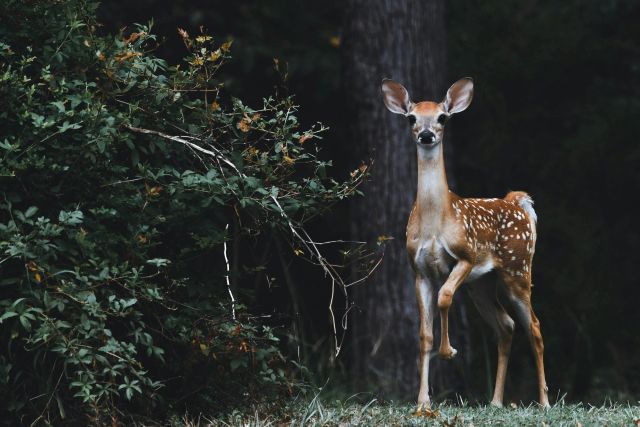
“I have a question.”
I turned my gaze to the man who had spoken. He was middle aged, short and squat, with a scruff of beard and a camouflage baseball cap.
“Why do all the deer here hang around people?”
I nodded and smiled. As a national park ranger stationed in the village of Apgar in Glacier National Park, this was not my first time answering this question.
“We keep them safe from predators,” I told him. “In the evenings the deer gather near people to feed because they know that their predators won’t come near people.”
“But why aren’t they afraid of us? At home they run from us.”
“Because they aren’t hunted by us here,” I told him. I addressed the twelve or so other folks along for my guided hike. “People aren’t a threat to the deer in a national park, because we don’t allow hunting.”
“But,” said the man, and I turned back to him, “why aren’t you overwhelmed with deer? I’ve only seen a handful; why don’t you have a population explosion if you don’t hunt them?”
And this is where I went from Pleasant Ranger Smile to Massive Ranger Grin. This man was teeing me up for one of my biggest hits.
A balanced ecosystem has predators.
“Because,” I told him, “deer have all their major natural predators here. Glacier has wolves, mountain lions, bobcats, lynx, wolverines, and black and brown bears. All of those predators will attack a fawn and some of them can take out a full grown deer. They keep the deer population in check. A balanced ecosystem has predators.”
I watched realization dawn on the man’s face–learning was happening. This was one of my favorite parts of the job.
I finished up my guided hike, but throughout the day I thought of this man and his questions. I thought about the time I lived in rural Texas, where a colleague told me of the entry fee for hunting expos she had attended. “Five predator hides,” she said. “They’re trying to exterminate all the predators of Texas.”
She was a park biologist and avid hunter and taxidermist, and, though she had made some incredibly lifelike taxidermied pieces from these same predator hides (like the coyote she would often hide in different locations in my office so that she could delight in my terrified screams every time I turned on the lights), she did see the beauty in those animals and the impact of killing them.
“The deer population here is massive; you really have to watch driving at night. I don’t think anyone puts that together with killing all the predators.”
No, it seems that most Americans do not, in my experience from discussing this topic with them at national parks, understand that killing all the predators is why you have a 1 in 139 chance every year of hitting an animal with your car (the vast majority of those animals being deer), a chance that goes up dramatically in areas of heavy deer populations, like in West Virginia where there’s a 1 in 40 chance.
And all of these places, the ones where deer have large populations, allow hunting. They encourage hunting. But they still have an overpopulation problem, which leads to much larger problems than just hitting one with your car.
Humans are impacted in countless ways by being surrounded by too many prey animals and not enough predators.
Denuded landscapes due to overgrazing by deer is not just an eyesore; it can create erosion and landslides. It can leave forests more susceptible to wildland fire and make it harder for them to regenerate. Overpopulations of deer also lead to reduced biodiversity of plants, meaning that one disease or disaster can wipe out entire plant communities.
And then there are tick-borne diseases and damages to crops. Humans are impacted in countless ways by being surrounded by too many prey animals and not enough predators.
But you know where they don’t have many of these issues? National parks that still have predators. Because you know what isn’t allowed in national parks? Hunting. And you know what is the first thing that would be hunted out of national parks if hunting was allowed? Predators.
The famous story of the return of wolves to Yellowstone illustrates this story. Wolves were once extirpated from the park, but then in 1995 they were reintroduced.
The deer population dropped and stabilized. The grasses and other vegetation returned. The streams and rivers in the park flooded less with edges strengthened by vegetation that could finally grow without an excess of deer mouths to consume it.
Larger fish populations returned to the rivers. Eagles came to feed on the fish and the bears feasted and grew fatter. All because the predators–the wolves–returned.
There has been a recent order by the Secretary of the Interior to open up US national parks and other federal lands to hunting. For context, there are already many US federal lands where hunting is allowed; if you want to hunt on federal lands you can do that.
But with this recent order the message from this Administration is clear; they are not satisfied with hunting on the millions of acres of public lands that already allow it. They want to go big-game hunting in America’s most protected lands–our national parks.
If hunting is allowed in national parks, the first thing the hunters will go after is the predators.
To those who would suggest that we hunt in national parks, I say this: “If you want to hunt, hunt the deer in your own backyard.” Since we have decimated predator populations across the nation, deer populations do need management.
But do you know where we don’t need the influence of hunters? National parks. Places with delicate ecosystems that are being conserved for all of us to enjoy.
If people were to hunt in national parks, I suspect they would not be gunning for deer. I imagine the people who want to hunt in America’s national parks want to shoot a bear. A mountain lion. A wolf.
I imagine what they mean when they say they want to hunt in national parks is that they want to kill predators or the rare species that exist in few other places.
If they want to kill threatened or endangered species, then that should remain illegal, even if national parks are opened to hunting. And if they want to slaughter the park’s predators, then they are essentially saying they don’t want these public lands to be preserved for future generations. They want to kill not just the native predators that are getting harder and harder to find but something else that is getting rarer in the world–an intact ecosystem.
If hunting is allowed in national parks, the first thing the hunters will go after is the predators. And once those are gone, the parks will be unrecognizable, with explosions in the populations of prey animals and the decimation of plant life.
Not all national parks have top predators, but all are working toward preserving their park’s complex ecosystem. Introducing hunting into the mix would destroy decades or even in some parks over a century’s worth of conservation efforts.
It would also be a failure of the national park service mission, which is to “preserve unimpaired the natural and cultural resources and values of the national park system for the enjoyment, education, and inspiration of this and future generations.”
All so some people who know nothing about the delicate nature of ecosystems get to shoot a wolf.
Inspired to support America’s public lands? Here are five ways you can help.