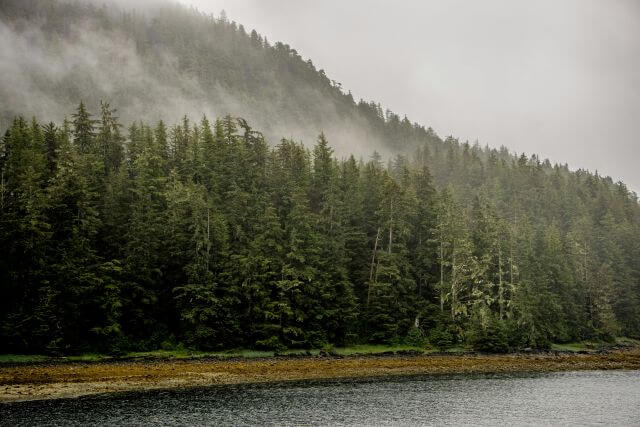
“Today we are going to talk about something called plant succession.” Those are words I said dozens of times, maybe more than a hundred times, back when I was a US national park ranger working in Glacier Bay National Park. Part of my job was to lead visitors on a 1-mile loop trail in the remote Alaskan rainforest. What I talked about, and what most of my colleagues talked about on our Forest Loop guided walks, was plant succession.
Plant succession is the scientific understanding of how plant life navigates from bare rock to mature forest over time. That progression–from lichens that turn rock to dirt, to nitrogen fixers that make that dirt into nutrient-rich soil, to trees that take root and build a forest–has happened many times on the edges of Glacier Bay, as glaciers have expanded and retreated over the landscape.
So I would talk about plant succession by the shoreline of the bay, pointing out the early plants and lichens, then identifying the ones that signify an immature but progressing ecosystem, and finally welcoming folks into the lush biome of a mature temperate rainforest.
A mature forest is stable and intradependent. Over the last several decades, researchers like Dr. Suzanne Simard have unearthed the network of reciprocity that forest plants use to feed, water, nurture, and communicate messages to one another. Fungal filaments connect the forest through the soil, allowing individual plants to unite, to give, to receive. To share.
Research has shown that a mature forest is one of collaboration, not competition. The Darwinist concept of “survival of the fittest” is mainly for those early, immature, and unstable periods of plant succession, when the ground is still disturbed by whatever disaster created the barren land (human activity, glacial melt, volcanic eruption, etc.).
At this immature stage, plants like nitrogen fixers (which take nitrogen–a key component of plant structure–from the air, use it to create their own bodies, and leave the excess in the soil) are jockeying for position. They do compete. But all that competition isn’t sustainable. Eventually monocultures face disease or limited resources and collapse.
A healthy forest grows all plants.
In plant systems, a collapse of an immature system results in a new wave of plants entering the chat–often plants ready to build a more stable ecosystem that will benefit all.
In human systems, these same principles apply. The US economy, for example, has for generations been rooted in a Darwinistic capitalism. The accompanying mentality that has planted itself in the psyche of many generations of Americans is one of greed and individualism. The “dream” of America has not historically been about building community with others but about individual achievement and stockpiling wealth.
As with plant communities, this level of competition is unsustainable. In nature, when plants overreach they are naturally rebuffed by limited resources or by other factors like disease. Right now, Americans are facing a similar collapse of our economic system because it is rooted in competition.
Unchecked greed is unsustainable in the world of plants and in the realm of human societies. What is sustainable? Collaboration. Sharing. Reciprocity.
If we Americans want to build a society and economy that are more stable, our next stage of development as a nation will need to be toward what is best for the growth of the community, not what is best for our individual greed.
There is a misconception among many, though, that doing what is best for the community will harm the individual. The opposite is in fact true; a system that supports all supports each. In other words, a healthy forest grows all plants.
We need to be like a mature forest and learn to share.
In a healthy, mature forest, a sick plant is rushed healing resources through the forest’s fungal network. The ill plant receives care, but those that offered resources are also helped. A sick plant might infect the others; it is in the best interest of the forest to care for its ill.
In a mature forest, the largest trees that receive a greater portion of the sunlight and therefore produce more food through photosynthesis flood the surrounding plants with their excess food instead of hoarding it. In return, the shaded plants provide the taller trees with resources to aid in photosynthesis–like water and nutrients. These plants need one another, and both the big and small ones grow stronger and survive longer because of the other.
Again, these same principles can be applied to human societies, and they are often applied in nations other than the United States, nations that look a lot more stable these days than us. The most stable human systems are consistently ones that care for their ill and where everyone is fed, housed, and treated with dignity. These systems are focused on the good of the community.
I am not suggesting that we try to imitate plants; I am explaining that we are already in fact like plants. Humans are natural; we are of this earth. Our systems follow the same patterns as those we witness in nature.
We learned our “survival of the fittest” competitor mentality from the scientific concepts of Darwin. Now we need to look to other scientific mentors–like Dr. Robin Wall Kimmerer, a Potawatomi botanist and author, who writes about the lessons plants can teach us.
When I walked the Forest Loop trail with park visitors, I explained the wisdom of plants, and then I would end the hike by sitting them by a pond and asking them to think about the healing power of change.
Change can be destructive; it can be terrifying. I don’t think most humans like change, and for valid reasons. But when things aren’t working, change is necessary. The only way to solve a systemic problem is through systemic change.
And after a big change–even an unpleasant one–things often get better. Because we learn. We heal. We grow.
We in the United States are in a moment of imminent change. What that change will be is uncertain, but there are guides as to what direction we might take growing all around us. We need to be like a mature forest and learn to share.